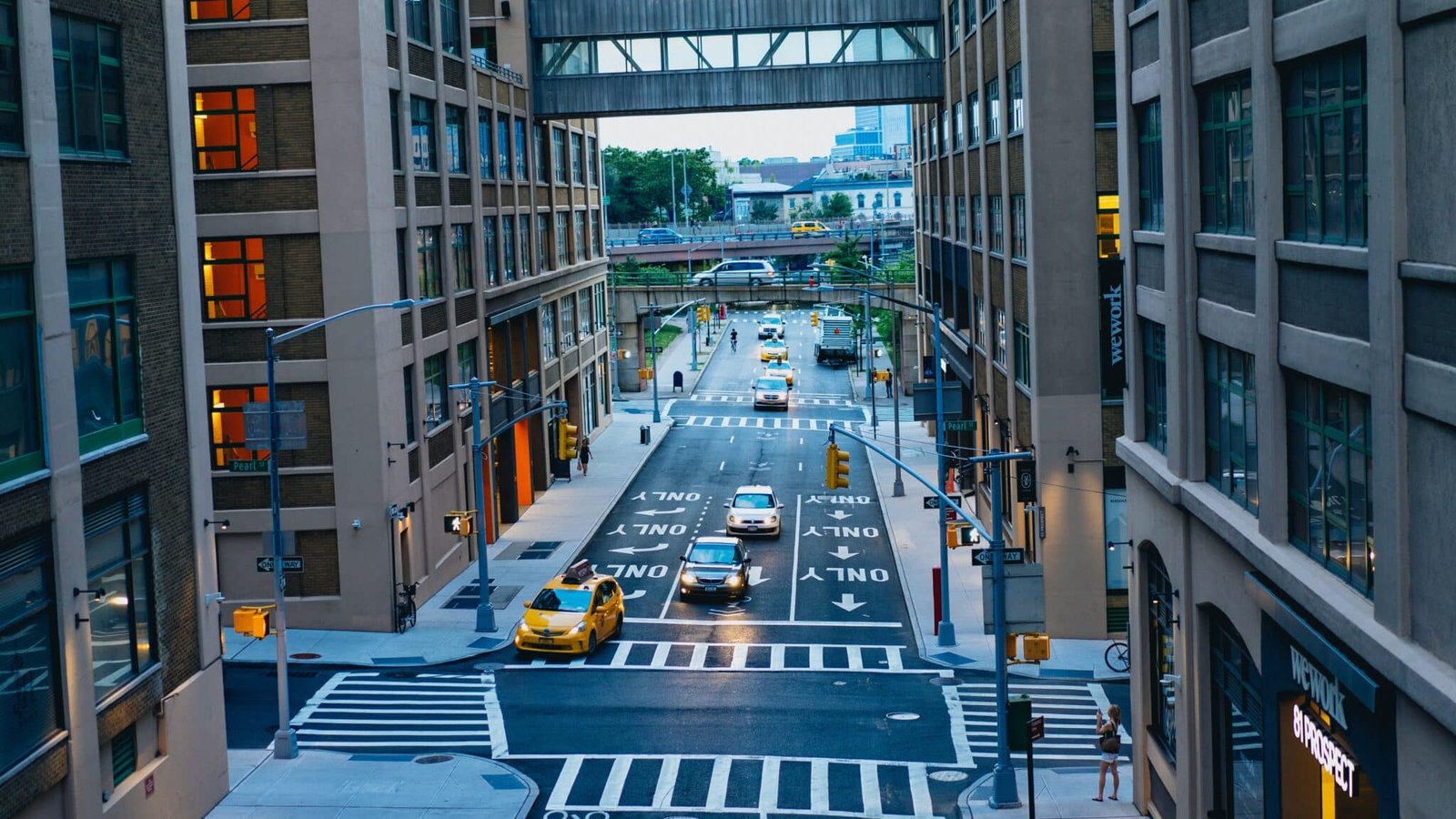

A street is a public space that connects residential areas to the wider road network, such as city main roads, and is one of the essential facilities of daily life. Since ancient times, streets in busy areas have been cleaned, paved, and improved, even though early roads were built using simple materials. With the development of transportation systems and increased vehicle use and traffic accidents, making street design essential for improving safety and facilitating traffic movement. In this context, the role of the engineer is to design and implement street projects in accordance with established standards for road and street construction.
The main elements that play a significant role in street design include travel lanes, pedestrian sidewalks, on-street parking, turning lanes, pedestrian crossings, driveway entrances, bus stops, speed control elements, and landscaped areas.

Before the start of any design, information about the location and topography of the project must be available. The right-of-way (road width) is determined by calculating the population and the density of transport users. Lane width is a critical factor in roadway design. A minimum lane width of 11 feet (3.0 m) may be used in constrained conditions, while 12 feet (3.65 m) is more appropriate for accommodating larger vehicles.

Pedestrian sidewalks are an essential part of urban areas. They enhance social interaction, encourage walking, support economic activity, and improve public health. Sidewalks make streets more attractive and should have a minimum width of 5 feet (1.5 m), allowing two people to walk side by side, but in high-activity areas such as schools, sports complexes, parks, and commercial zones, a minimum width of 8 feet (2.4 m) is recommended.


A curb extension is a physical and visual narrowing of the roadway, achieved by extending the curb into the travel lane. It provides several benefits, particularly at pedestrian crossings, by shortening crossing distances and improving pedestrian visibility. Curb extensions also create space for on-street parking, street furniture, trees, and landscaping, while contributing to traffic calming. They are suitable for use in urban areas, neighborhoods, and residential streets. On a street with an 8-foot (2.4 m) on-street parking lane, curb extensions are typically 6 feet (1.8 m) wide, and a minimum clear width of 13 feet (3.96 m) must be maintained. This ensures access for emergency and maintenance vehicles.
 A
A
At the same time, speed control plays a significant role in reducing traffic accidents and providing a more attractive and safer environment. Several measures are used to control vehicle speed on streets, such as curb extensions, which increase driver awareness. Reducing the turning radius at driveway entrances and intersections also helps limit vehicle speed. Conversely, a smaller turning radius prevents drivers from increasing speed while turning. Installing speed humps or raised crosswalks near intersections and pedestrian crossings helps slow vehicles and improve safety. These measures significantly reduce the risk of serious injuries and fatalities.

Installing greenery and trees improves the visual quality of streets and plays a significant role in reducing stormwater accumulation and flood risk. Using pervious surfaces, such as landscaped areas and permeable materials, helps offset the effects of impervious paved surfaces. However, tree species and placement must not obstruct driver visibility. The appropriate type and location should be determined by the design engineer.